The following announcement was issued today to a Regulatory Information Service approved by the Financial Conduct Authority in the United Kingdom.
DFI RETAIL GROUP HOLDINGS LIMITED
2025 PRELIMINARY ANNOUNCEMENT OF RESULTS
Highlights
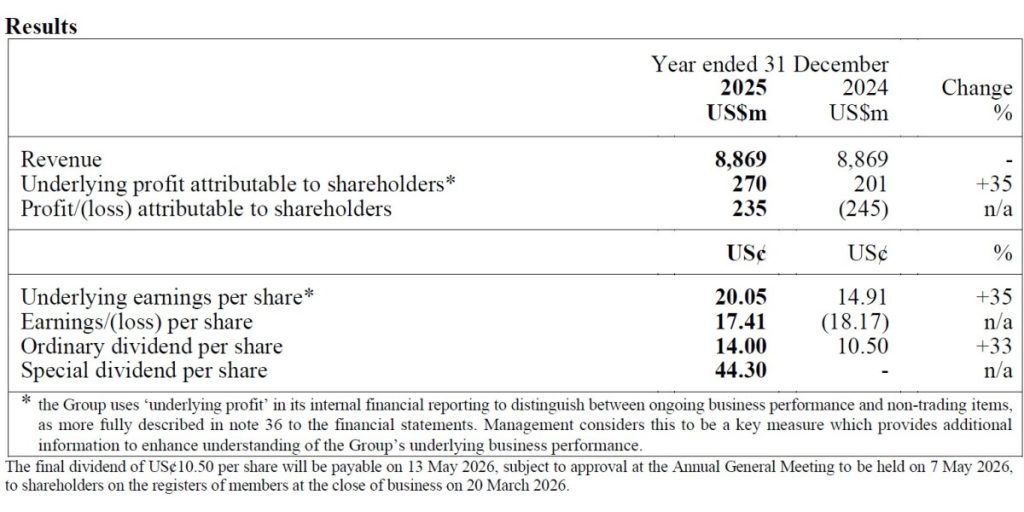
Underlying profit reached the high-end of guidance at US$270 million, up 35% year-on-year
Reported profit of US$235 million, up US$480 million year-on-year
Health and Beauty delivered strong like-for-like (LFL) sales and profit growth
Convenience returned to profit growth in the second half of 2025, supported by a favourable mix shift towards higher-margin, non-cigarette categories
Strengthening value-driven, omnichannel proposition in Food and Home Furnishings
Divestments of Yonghui, Robinsons Retail and Singapore Food underscored the Group’s transition from a portfolio to a focused operating company and strengthened balance sheet to a net cash position
Returned approximately US$740 million to shareholders for the full year 2025, including a US$600 million special dividend
Final dividend of US¢10.50 per share based on a new 70% payout policy announced in December 2025
“Effective execution of our strategy drove strong financial performance and higher shareholder returns in 2025, despite a challenging retail environment. Our significant progress made in portfolio simplification creates investment capacity for strategic priorities, enabling greater value for our customers and accretive inorganic opportunities to drive sustainable growth and returns.”
Lincoln Pan
Chairman
DFI RETAIL GROUP HOLDINGS LIMITED
PRELIMINARY ANNOUNCEMENT OF RESULTS
FOR THE YEAR ENDED 31 DECEMBER 2025
INTRODUCTION
It is my honour and privilege to join DFI Retail Group (‘DFI’ or the ‘Group’) as Chairman of the Board, supporting Group Chief Executive, Scott Price, and his leadership team in executing its strategic priorities and delivering shareholder returns. On behalf of the Board, I would also like to express our gratitude to John Witt for his invaluable contributions to DFI over many years.
As Asia’s leading multi-format retail platform, DFI has a unique set of assets – strong customer trust, an extensive store network across markets, deep data insights from a powerful loyalty programme, and a strengthening Own Brand portfolio – that will serve as a foundation for growth over the coming years.
Amid macroeconomic volatility and evolving consumer needs, the Group has been responding effectively through a stronger value proposition and enhanced omnichannel capabilities. This strategy is yielding early and encouraging results, demonstrated by a 35% increase in underlying profit in 2025. We remain particularly optimistic about the growth prospects in Health & Beauty and Convenience, as well as the opportunities emerging in digital.
I am confident that under the capable leadership of Scott and his team, DFI will continue to deliver retail excellence to customers across Asia while driving long-term value creation and growth.
Under a new 70% dividend payout policy announced in December 2025, the Board recommends a final dividend of US¢10.50 per share (2024 final dividend: US¢7.00).
STRATEGIC HIGHLIGHTS
Over the course of 2025, the Group executed effectively against its strategic framework of Customer First, People Led, Shareholder Driven. This approach enables DFI to navigate market challenges while capturing opportunities that build on its strong platform for sustainable growth.
The retail landscape is rapidly evolving, driven by shifting consumer behaviour and digitalisation. The Group remains focused on strategic priorities that place customers first – delivering quality, value and convenience in everyday moments. Across its businesses, the Group made good progress in strengthening value propositions, expanding customer reach in growth markets, driving deeper customer engagement with data-driven insights and accelerating digital monetisation. These initiatives enhance its ability to better serve customers and supplier partners while delivering returns to shareholders.
Investing in talent development remains at the top of the agenda. During the year, the Group achieved an improved team member engagement score. Inclusive leadership, a purpose-driven culture and engaged team members are critical to driving stronger performance and delivering exceptional customer experience. In parallel, the Group continues to enhance its organisational agility in meeting customer needs while reducing overhead costs.
In 2025, the Group completed the divestments of minority stakes in Yonghui and Robinsons Retail, as well as Singapore Food business, enabling reinvestment in subsidiary businesses and strategic priorities with stronger growth and return potential. This approach, combined with a sharpened business focus and a strengthened balance sheet, delivered a total shareholder return exceeding 90% in 2025, including the distribution of a US$600 million special dividend in October.
PROSPECTS
Transformation is an ongoing journey for today’s retailers. Serving diverse communities across Asia, where economic conditions and consumer expectations vary widely, the Group must stay agile and locally relevant guided by a customer-first mindset and a disciplined focus on growth opportunities that further build on its competitive advantages. Over the year, DFI has invested in delivering better outcomes for customers through price reinvestment, Own Brand innovation, omnichannel expansion and data-driven personalisation – focus areas that will remain central to its growth plans in the years ahead. An expanded digital ecosystem also unlocks new avenues to drive deeper value for supplier partners and enhance shareholder returns.
I would like to end by expressing the Board’s appreciation to our team members. We could not be more proud of the work they have done over the year, particularly in responding to the deeply tragic Tai Po fire in Hong Kong. Their unwavering dedication to serving our customers across Asia is what will continue to drive our business forward and build long-term value for shareholders.
Lincoln Pan
Chairman
GROUP CHIEF EXECUTIVE’S REVIEW
INTRODUCTION
We are pleased to close 2025 on a strong note, with underlying profit attributable to shareholders up 35% year-on-year to US$270 million, reaching the high end of our guidance range. This strong performance was driven by a recovery in LFL subsidiary sales, improved margins and proactive portfolio actions, including the divestment of our minority stake in Yonghui.
Customers across Asia, including in our home market of Hong Kong, are increasingly seeking quality and convenience at great value. While macro challenges remain, we are encouraged to see early signs of recovery in key retail segments, including 3% growth in health and beauty sales in Hong Kong, supported by a 12% increase in tourist arrivals. As Asia’s leading multi-format omnichannel retail platform, we are uniquely positioned to meet customers’ evolving needs effectively across all channels through relevant and compelling customer propositions.
With a renewed focus on balancing profitability with capital discipline, the Group ended the year in a net cash position, after distributing a US$600 million special dividend, and delivered a significantly improved return on capital employed (ROCE) of 9.4%. Our strengthened balance sheet allows us to reinvest for growth as we deepen our focus on higher-return subsidiary businesses and strategic priorities that sustain value creation for shareholders. For the full year 2025, we returned a total of approximately US$740 million to shareholders, including the special dividend.
In December, we held our inaugural Investor Day where DFI announced a new dividend policy with an increased payout ratio of 70%. Dividends paid during the year, combined with a share price increase of more than 70%, resulted in a total shareholder return exceeding 90% in 2025. We also outlined our three-year plan for realising our financial ambitions and accelerated growth goals, including a target of US$310-350 million in underlying profit (representing 11% CAGR at the mid-point compared to 20251) and an improved ROCE of at least 15% by 2028.
As we enter the new financial year, we remain firmly focused on executing our strategic priorities to drive sustained, profitable growth.
STRATEGIC DELIVERABLES – KEY PROGRESS
Over the past year, we have made significant progress in our transformation from a portfolio business into a strategically focused operating company. We have been advancing our strategy across five key deliverables to create greater value for our customers, supplier partners and shareholders.
Retail Excellence
By delivering best-in-class customer propositions, we see a wide range of opportunities for driving higher store sales density and market share gain across all business segments.
Health & Beauty
Mannings and Guardian continue to strengthen their position as the trusted advisor for wellness, unlocking strong cross-category growth opportunities through an assortment with high functional value across supplements, derma skin care and hair care. Customers across Asia are increasingly shifting to retailers that best fulfil their broad, diverse and unique wellness goals. Our technology-enabled personalised services – including skin, scalp and health assessments – drive higher purchase conversion and basket size by deepening customer understanding of their wellness needs. These capabilities will be expanded to 25% of our Health & Beauty store network to enhance our competitive differentiation and leadership in wellness.
Convenience 7-Eleven is broadening its shopper missions towards higher-margin, non-cigarette categories with a strategic focus on ready-to-eat (RTE) offerings, which accounted for 24% of Convenience sales in 2025. Across markets, consumers are seeking more convenient, high-quality and value-driven meal solutions. The expansion of Food Bars to 1,250 locations in South China and the rollout of RTE-focused store revamp across the entire Hong Kong network by 2028 will further strengthen 7-Eleven’s RTE proposition.
Food
Given consumers’ pivot towards value, continued northbound travel and increasing competition from Chinese mainland e-commerce platforms, the Wellcome team has focused on enhancing food basket value for customers by advancing our Everyday Low Price strategy. Investment in reduced pricing through strategic direct sourcing of core basket items, particularly in fresh, has resulted in a 2% growth in volume driven by higher footfall and increased items per basket. Direct sourcing allowed us to reduce prices while protecting gross profit, resulting in a 30-basis point gross margin improvement. These efforts further supported the narrowing basket price gap compared to the Greater Bay Area to a currently low single-digit price difference2.
Home Furnishings
Similar to Food, IKEA has focused on enhancing its affordability and accessibility by reinvesting in the pricing of high-volume products, broadening the range of entry price points, rationalising the tail of slow-selling assortment, and further expanding digital touchpoints through third-party marketplaces. We are also strengthening IKEA Food as a key draw for customers seeking exciting and affordable food experiences as part of their store journey. These efforts are supported by significant cost transformation initiatives across our operating markets.
Own Brand
Our reset in Own Brand strategy across Food and Health & Beauty is driving higher customer loyalty and sales penetration through greater exclusivity and value. By refining our product range to align closely with customer needs and maximising cross-selling across our formats, we achieved meaningful improvements in margins and sales productivity.
Access to Customers
We continue to strategically expand our network in high-growth, profitable markets, primarily through a capex-light franchise model, with 114 net new openings3 in 2025. In particular, we will deepen 7-Eleven’s presence in Guangdong province to around 2,400 stores and expand Guardian’s footprint in Indonesia to approximately 750 stores by 2028.
Omnichannel and Data Ecosystem
DFI’s expanded omnichannel ecosystem is elevating our relevance and engagement with customers, providing us deep data insights across daily consumer needs that few peers in Asia can match. This ecosystem now allows our customers to engage with DFI brands across more than 90 digital channels, including apps, websites, third-party marketplaces, quick-commerce partnership with food delivery platforms and click-and-collect services. Our strengthened digital proposition was underpinned by a 140-basis point increase in online sales penetration to 6.4%4 as at year-end 2025, with order volume more than doubled year-on-year. Our overall digital ecosystem, comprising e-commerce, retail media, insights monetisation and yuu, continues to drive improved financial returns for the Group.
Retail Media (DFIQ Media)
Positioned to become Asia’s leading omnichannel retail media network, DFIQ Media offers a differentiated online and offline advertising proposition, enabling brands to execute cross-format campaigns through our digital assets and more than 10,000 in-store digital screens across markets. DFIQ Media delivered strong sales growth, albeit from a low starting base, achieving a fourfold increase in revenue over 2024, supported by proprietary data insights from over 7 million monthly active users across our growing digital portfolio.
DFIQ Portal
We aim to empower our supplier partners with actionable insights that drive greater business impact and better outcomes for customers. The DFIQ Portal – a vendor platform combining DFIQ Media, DFIQ Insights and trade capabilities – was launched in December 2025, providing suppliers real-time access to critical analytics that enables optimised inventory management and more effective strategic planning.
Retail Analytics
Leveraging cross-format data insights from over 5 million yuu Rewards members in Hong Kong, we continue to enhance our assortment and promotional decisions to help expand both in-store sales and gross profit.
Lean & Agile Model
Maintaining a lean and agile operating model is essential to ensuring efficient decision-making in a rapidly evolving retail landscape. Continued cost optimisation and better product sourcing will support both strategic price reinvestment and sustainable margin expansion in the coming years. Overhead reductions are expected to translate into lower SG&A costs beginning 2026. We remain disciplined in capex, driving network growth primarily through a franchise model with a strong focus on paybacks.
Strategic pivot from portfolio to a focused operating company
We conduct strategic reviews of our businesses guided by return on capital and total shareholder return priorities. During the year, we completed the divestment of our minority stakes in Yonghui and Robinsons Retail, as well as our Singapore Food business, generating total gross proceeds of approximately US$1 billion in cash consideration. In line with our capital allocation priorities, these proceeds were redeployed towards debt repayment, resulting in a net cash position of US$70 million as at year-end 2025. In addition, a special dividend of US$600 million was distributed to shareholders in October 2025. The Group remains focused on maximising total shareholder return while maintaining strategic flexibility for inorganic growth opportunities that are accretive to long-term shareholder value.
2025 PERFORMANCE
Total revenue from subsidiaries in 2025 was US$8.9 billion, up 1% on a LFL basis, excluding cigarettes. Organic revenue, excluding divested businesses5 for the comparable period, grew 0.5%. Strong sales growth in the Health & Beauty division was offset by lower contributions from other segments.
Excluding the impact of the minority stake divestments in Yonghui and Robinsons Retail completed in 2025, total revenue for the Group, including 100% of associates and joint ventures, remained broadly stable.
The Group reported total underlying profit attributable to shareholders of US$270 million for the year, up 35% year-on-year. This was supported by improved profitability from subsidiary businesses, lower financing costs and higher underlying profit from associates following the divestment of Yonghui.
Underlying profit from subsidiaries was US$183 million, 15% higher than the prior year. This was driven by strong Health & Beauty performance in addition to earnings recovery in Singapore Food and Home Furnishings segment, partially offset by lower contribution from Convenience due to reduced cigarette volume.
The Group’s share of underlying profit from associates was US$88 million, an improvement of US$45 million compared to the prior year, primarily due to the divestment of minority stake in loss-making Yonghui and higher contribution from Maxim’s as a result of improved mooncake sales and restaurant performance in Southeast Asia. Despite challenging trading conditions in Hong Kong and Chinese mainland, Maxim’s delivered profit growth in these regions through cost optimisation.
The Group reported operating cash flow after lease payments of US$430 million, 30% higher than the prior year, supported by underlying operating profit growth. Free cash flow6 for the period was US$281 million, up 78% year-on-year. As at 31 December 2025, the Group’s net cash was US$70 million, compared to US$468 million net debt at 31 December 2024.
SUSTAINABILITY
We remain firmly committed to our purpose to sustainably serve Asia for generations with everyday moments – with a focused, balanced, collaborative approach taking into account the macroeconomic environment and consumer sentiment. We are driving progress on our pathway to reduce our Scope 1 and 2 emissions by 50% by 2030 from a 2021 baseline, with our targeted investments in refrigerant emissions management, energy efficiency, and behaviour-change initiatives across our operations gaining momentum throughout the year. From 2025 to 2030, we will further increase the share of renewable energy use in our portfolio, helping to accelerate the energy transition in the key markets where we operate.
As advocates for our customers and the communities we serve, we are committed to delivering affordable, sustainable products. In 2025, we delivered 380 tonnes of Own Brand low-carbon rice to our Hong Kong markets and added multiple products through our Grounds to Green programme to our 7-Eleven RTE range. These award-winning initiatives demonstrate our ability to anticipate customer expectations and deliver on market demands. We maintained strong discipline in waste and packaging management, keeping us on track to meet our 2030 targets.
BUSINESS REVIEW
HEALTH AND BEAUTY
Sales for the Health and Beauty division grew 7% year-on-year or 5% on an LFL basis to US$2.6 billion. Underlying operating profit was US$228 million for the year, representing an increase of 8% compared to 2024.
Both Mannings and Guardian achieved strong LFL sales performance, supported by growing wellness sales penetration towards the mid-term target of over 35%. To further strengthen our leadership in wellness – a cross-category opportunity spanning health, beauty and personal care – Mannings and Guardian complemented their wellness-focused assortment with in-store health, skin and scalp assessments in selected outlets. Our personalised consultations and tailored product recommendations deepen our engagement with customers, supporting larger basket sizes and higher purchase conversion.
In Hong Kong and Macau, LFL sales increased by 5%, driven by strong growth in tourist store sales from higher arrivals. Own Brand strategy reset resulted in a 35% improvement in gross profit per SKU through a refined product range that better aligns with customer needs. Sales of Mannings China declined due to the closure of majority of its offline store network as the business pivots towards a cross-border e-commerce model.
Guardian in Southeast Asia reported 5% LFL sales increase, driven by growth in basket sizes across key markets and an expanding e-commerce presence, including the Guardian Malaysia loyalty programme launched in March 2025 and a new Guardian Singapore app in July 2025. Indonesia and Vietnam delivered LFL sales growth exceeding 10%, supported by strong traffic gains. Gross margin expansion and operating leverage contributed to operating profit growth of 16% in the region.
CONVENIENCE
Total Convenience sales were US$2.3 billion, representing a decline of 2% year-on-year or 3% on an LFL basis, due to lower-margin cigarette volume reductions following tax increases in Hong Kong in February 2024. Excluding cigarettes, overall Convenience sales grew 1% compared to 2024 and were marginally lower on an LFL basis. Underlying operating profit was US$97 million, down 6% year-on-year. Favourable sales mix shift towards higher-margin non-cigarette categories drove a return to a positive profit growth in the second half of 2025.
In Hong Kong, the Group expects to mitigate financial impact from declining cigarette sales in 2026 and beyond through continued growth in higher-margin non-cigarette categories, including RTE which accounted for 18% of sales for the full year, up from 16% in 2024.
7-Eleven Singapore reported robust LFL sales growth driven by a stronger RTE proposition and effective promotional campaigns. In South China, continued store network expansion through a capex-light franchise model, including 99 net increase in store number, contributed to 3% sales growth. LFL sales, however, were down 2% largely due to intense subsidy competition from food delivery platforms, primarily in the first half of the year. The focus remains on driving footfall through innovative RTE and Food Bar expansion to 1,250 stores by the end of 2028, compared to 325 as of year-end. Both markets saw meaningful profit growth, supported by a favourable product mix shift and disciplined cost control.
FOOD
Reported sales for the Food division were US$3.0 billion, remaining stable compared to 2024 on an LFL basis. Underlying operating profit reached US$62 million for the year, up 6% year-on-year, driven by earnings recovery in Singapore Food following the distribution of government consumption vouchers in 2025.
In Hong Kong, the Wellcome team strengthened its fresh and value proposition through pricing reinvestment supported by strategic direct sourcing. These efforts included a new partnership with Dingdong Maicai (DDL) since May 2025 for a wider selection of price-competitive fresh produce, as well as the Everyday Value campaign launched in September 2025, offering up to 40% savings on 100 core basket items. The team also accelerated omnichannel growth through broader digital channels – including a quick-commerce partnership with foodpanda and click-and-collect services – and a shortened delivery time to same or next day delivery, driving a more than 20% sales growth in Hong Kong Food online sales. Despite a 1% LFL sales decline compared to the prior year, total volume grew 2% driven by increased transactions and items per basket.
Southeast Asia Food sales performance benefited from multiple rounds of government consumption voucher distribution in Singapore during the year, including S$800 vouchers for each household and S$600 vouchers for individuals in celebration of the nation’s 60th anniversary. These vouchers, which were redeemable at supermarkets and heartland merchants, drove stronger sales in the Food segment. Convenience and Health & Beauty did not see a similar uplift in sales as the vouchers were not applicable to these outlets. Divestment of Singapore Food business was completed in early December 2025. Post-completion, the Group continues to serve the Singapore market through its Guardian and 7-Eleven brands. As the only nationwide modern trade operator in Cambodia, Lucky reported robust LFL sales growth with strong margin expansion on scale benefits.
HOME FURNISHINGS
IKEA reported sales of US$677 million, down 3% year-on-year and 5% on an LFL basis, compared to an 11% LFL sales decline in 2024. Operating profit was US$26 million, representing a meaningful improvement from US$16 million in the prior year, driven by effective cost control measures across markets.
Amid a challenging macro environment and reduced consumer demand for big-ticket items due to subdued real estate market activity, the IKEA team has prioritised enhancing its value proposition and omnichannel presence. Key initiatives include price reductions on high-volume products, rationalisation of non-core assortment, and a broader range of entry price points. In Indonesia, the team has further expanded digital partnerships with third-party marketplaces to improve accessibility, supporting continued progress towards its overall online sales penetration target of 18-20% by 2028. IKEA Food remains a critical traffic and revenue driver, representing 14% of total sales.
These combined with significant cost optimisation efforts in labour, supply chain and infrastructure across markets contributed to a US$10 million improvement in overall profitability.
RESTAURANTS
The Group’s share of Maxim’s underlying profits was US$72 million in 2025, an increase of 9% year-on-year, supported by resilient sales of US$3.1 billion, up 0.4% year-on-year, and ongoing cost optimisation. Improved mooncake sales during the mid-autumn festival and stronger restaurant performance in Southeast Asia was offset by challenging trading environment in Hong Kong and the Chinese mainland. Cost management in these markets also supported overall profit growth. During the year, Maxim’s continued to expand its Southeast Asia network with 84 net new stores added, mainly in Thailand and Vietnam.
OUTLOOK
2025 marked a year of strong progress for DFI, with the strategic reset across our businesses driving improved underlying profitability in both subsidiaries and associates, a stronger ROCE and enhanced shareholder returns. Our strengthened balance sheet and disciplined use of capital provides capacity to reinvest for growth both organically and inorganically, laying a strong foundation as we pursue our financial ambitions of achieving a US$310-350 million underlying profit (+11% CAGR at midpoint compared to 20257) and a 7-10% online sales mix by 2028.
At our inaugural Investor Day, we outlined clear strategic priorities which include strengthening our value proposition, enhancing omnichannel capabilities, accelerating Own Brand innovation, deepening digital monetisation, and leveraging data to deliver better outcomes for both customers and supplier partners.
For the full year of 2026, the Group expects organic revenue growth of approximately 2-3%8 and underlying profit attributable to shareholders to be between US$270 million and US$300 million. Excluding the divestment impact of Singapore Food and Robinsons Retail, this would represent a year-on-year growth of 13-25%.
Looking into 2026 and beyond, I am confident that DFI has developed a renewed foundation as we execute against our strategic priorities to deliver sustained, profitable growth, drive market share gains across our formats and generate long-term returns for our shareholders.
Scott Price
Group Chief Executive
—————– 1 Excluding Singapore Food business and minority stake in Robinsons Retail upon completion of divestment in 2025 2 Based on a third-party assured price comparison of a 200-item comparable basket between DFI and Greater Bay Area
3 Excluding Singapore Food. Divestment of business was completed in early December 2025. 4 Excluding Singapore Food, cigarettes under Convenience and IKEA food 5 Excluding financial contribution from Singapore Food (December 2024) and Hero Supermarket (2024) for comparison purpose 6 Free cash flow is equivalent to cash flows from operating activities after lease payments minus normal capital expenditure
7 Excluding Singapore Food business and minority stake in Robinsons Retail upon completion of divestment in 2025
The issuer is solely responsible for the content of this announcement.
DFI Retail Group
DFI Retail Group (the Group) is a leading Asian retailer, driven by its purpose to ‘Sustainably Serve Asia for Generations with Everyday Moments’.
At 31 December 2025, the Group and its associates operated 7,580 outlets across 12 markets, of which 5,529 stores were operated by subsidiaries. The Group, together with associates, employed over 79,000 people, with some 42,000 people employed by subsidiaries. The Group had reported revenue of US$8.9 billion in 2025.
The Group is dedicated to delivering quality, value and service to Asian consumers through a compelling retail experience, supported by an extensive store network and highly efficient supply chains.
The Group and its associates, operates a portfolio of well-known brands across five key divisions. The principal brands are:
Health and Beauty
• Mannings on the Chinese mainland, Hong Kong and Macau S.A.R.; Guardian in Brunei, Indonesia, Malaysia, Singapore and Vietnam.
Convenience
• 7-Eleven in Hong Kong and Macau S.A.R., Singapore and Southern China.
Food
• Wellcome and Market Place in Hong Kong S.A.R.; San Miu in Macau S.A.R.; Lucky in Cambodia.
Home Furnishings
• IKEA in Hong Kong and Macau S.A.R., Indonesia and Taiwan.
Restaurants
• Hong Kong Maxim’s group on the Chinese mainland, Hong Kong and Macau S.A.R., Cambodia, Laos, Malaysia, Singapore, Thailand and Vietnam.
The Group’s parent company, DFI Retail Group Holdings Limited, is incorporated in Bermuda and has a primary listing in the equity shares (transition) category of the London Stock Exchange, with secondary listings in Bermuda and Singapore. The Group’s businesses are managed from Hong Kong. DFI Retail Group is a member of the Jardine Matheson group.


 Media OutReach Newswire