
 Paul Arithi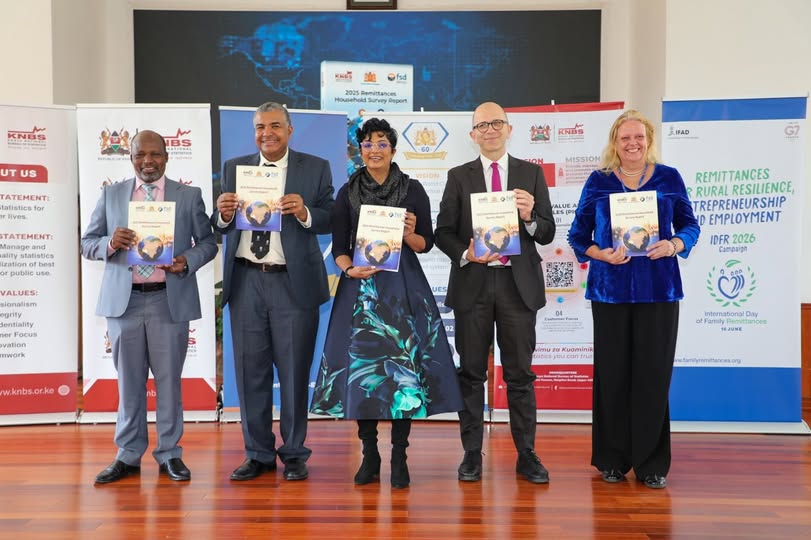
- Remittances Surge as Kenya’s Most Reliable Economic Lifeline;
For years, Kenya’s growth story has been told through the familiar pillars of agriculture, tourism, and increasingly, technology.
 Yet beneath these visible engines lies a quieter force less discussed in policy speeches but deeply felt in household budgets across the country: diaspora remittances.
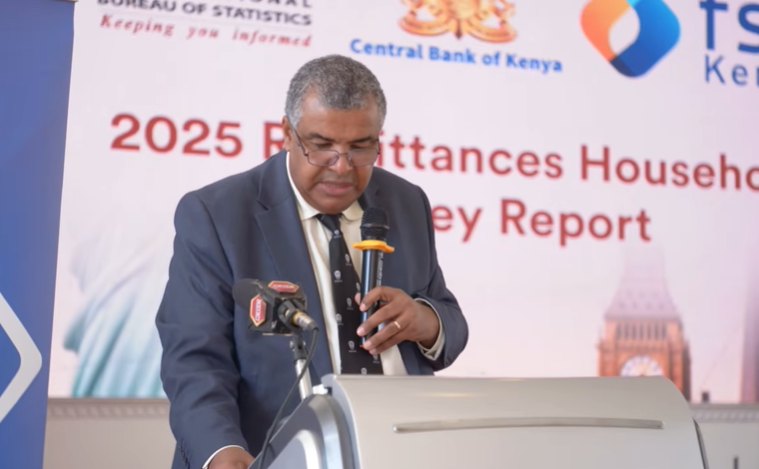
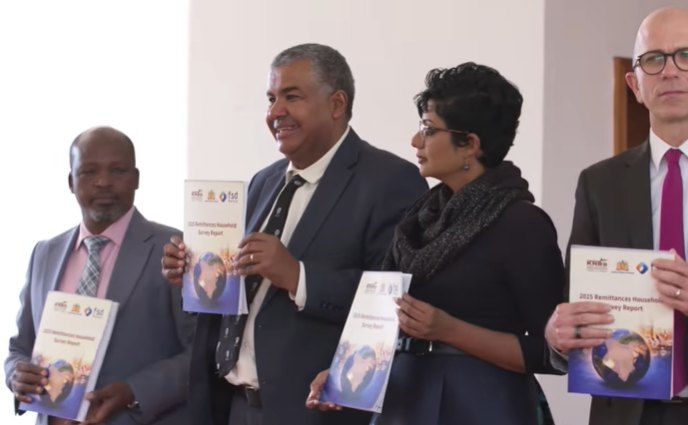
The 2025 Remittances Household Survey, jointly anchored by the Central Bank of Kenya (CBK), Kenya National Bureau of Statistics (KNBS), and Financial Sector Deepening Kenya (FSD Kenya), offers a more textured understanding of this parallel economy.
 What emerges is not just a flow of money from abroad, but a structured financial lifeline that is reshaping consumption patterns, household resilience, and Kenya’s external stability.
In 2024, remittance inflows reached KSh 666.7 billion, up from KSh 586.0 billion in 2023, accounting for roughly 4% of GDP. On paper, it is a macroeconomic indicator.
 On the ground, it is rent paid on time in Umoja, school fees settled in Eldoret, hospital bills cleared in Mombasa, and groceries stocked in Kisii.
The survey makes a critical point:Kenya’s remittance economy is no longer supplementary. It is structural.
It now sits alongside exports as one of the country’s most dependable sources of foreign exchange, cushioning the shilling during global shocks and offering a steady counterweight to volatile capital flows.
 If macroeconomics explains scale, the household lens explains purpose.
The survey reveals that remittances are overwhelmingly directed toward consumption and welfare needs. School fees dominate.
Healthcare follows closely.Daily consumption food, rent, utilities—absorbs a significant share, particularly in lower-income households.
 This pattern paints a clear picture of function: remittances are less about wealth accumulation and more about income substitution and shock absorption.
In many households, they operate as a parallel salary—one earned thousands of kilometres away, yet deeply embedded in Kenya’s domestic consumption cycle.
One of the most striking structural shifts highlighted in the survey is the consolidation of formal channels.
Banks, mobile money platforms, and licensed money transfer operators now dominate remittance flows.Kenya’s mobile money ecosystem, already one of the most advanced globally, has effectively become the backbone of cross-border household finance.

Yet the system is not entirely formalised. Informal channels cash carried by travellers, unregulated transfers within border communities, and ad hoc family networks, remain active, particularly for smaller or urgent transactions.
This duality reflects a transitional financial landscape: one foot in digitised global finance, the other still grounded in trust-based informal networks.
 Beyond households, remittances play an increasingly strategic role in macroeconomic management.
CBK has repeatedly pointed to diaspora inflows as a stabilising force for Kenya’s foreign exchange reserves.Unlike portfolio flows, which can exit rapidly in response to global risk sentiment, remittances tend to be sticky—driven by family obligations rather than market cycles.
Even during periods of global uncertainty, inflows have remained resilient, supported by stable diaspora employment in North America, Europe, and the Middle East, alongside expanding digital transfer infrastructure that reduces friction and cost.
Despite their scale, remittances remain largely consumption-driven. This is where the tension in the story lies.
Policy discourse increasingly focuses on a familiar question: how does Kenya convert a consumption-heavy inflow into productive capital?
The survey points to an emerging opportunity space:
- diaspora-linked housing finance
- SME investment channels
- lower-cost transfer corridors
- structured diaspora bonds and savings instruments
- improved data capture of informal flows
The implication is clear:Kenya has already solved the problem of attracting remittances. The next frontier is rechanneling them from household survival to economic transformation.
 What the 2025 survey ultimately confirms is that remittances are no longer peripheral to Kenya’s economic architecture.
In many ways, Kenya’s development story is now partially outsourced—not in policy or sovereignty, but in income generation.
 And as global migration patterns evolve, that dependency is likely to deepen before it diminishes.
The challenge for policymakers is no longer whether remittances matter.It is how to ensure that a financial lifeline, currently tuned to survival, can also become a lever for long-term structural growth.
Views: 17